
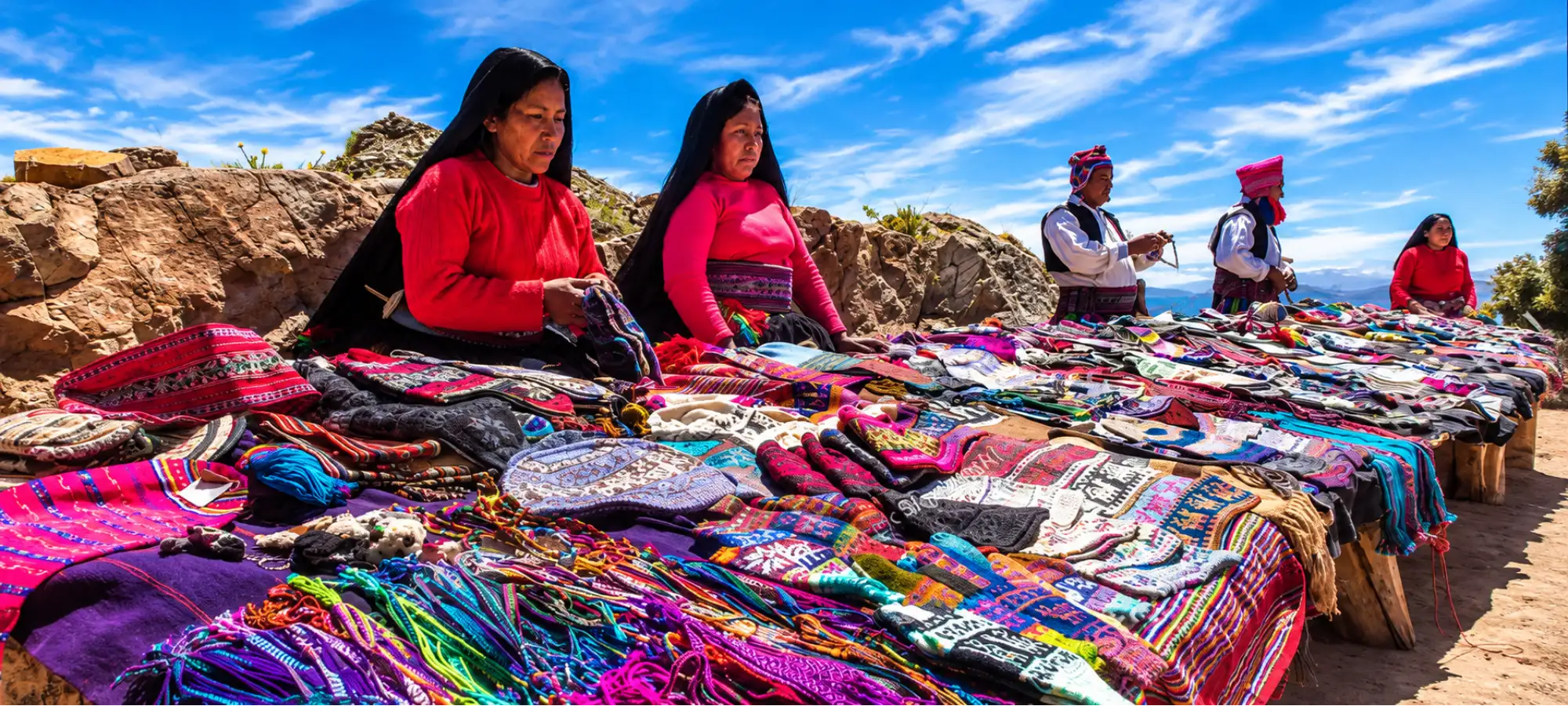
On a small island surrounded by the deep blue waters of Lake Titicaca, textiles are much more than colorful handmade souvenirs. On Taquile Island, weaving is part of a living cultural tradition passed from one generation to another.
The famous Taquile Island textiles reflect technical knowledge, community traditions and forms of cultural identity that have developed over generations.
Men and women participate in different aspects of textile production, while garments such as knitted hats and woven belts can carry meanings that extend beyond their practical use.
The importance of this tradition has also received international recognition from UNESCO.
Understanding the textile art of Taquile before visiting the island can completely change the way you experience this part of Lake Titicaca.
What are Taquile Island textiles?
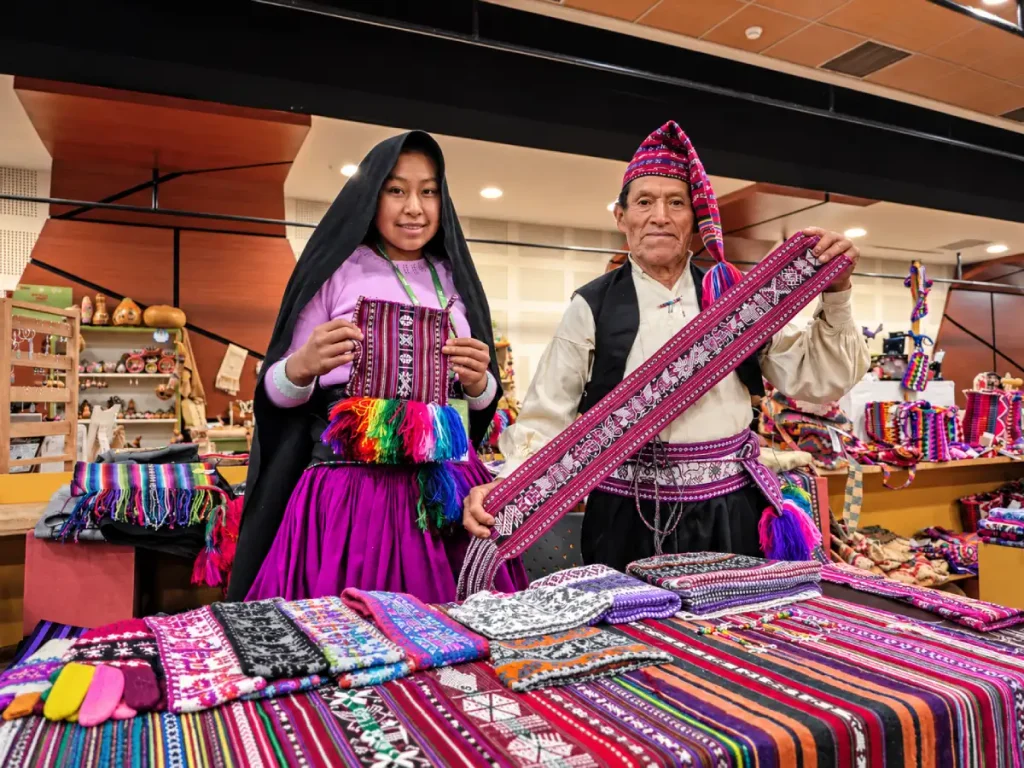
The textiles of Taquile Island include different garments and woven pieces created using techniques learned and practiced within the community.
Visitors may encounter knitted hats, belts, clothing and other handmade textiles during their time on the island.
These pieces should not be understood simply as handicrafts produced for tourism.
Textile knowledge has long been connected to everyday life, social relationships and cultural identity on Taquile.
Skills are traditionally learned from an early age and developed through years of observation and practice.
Why are Taquile textiles famous?
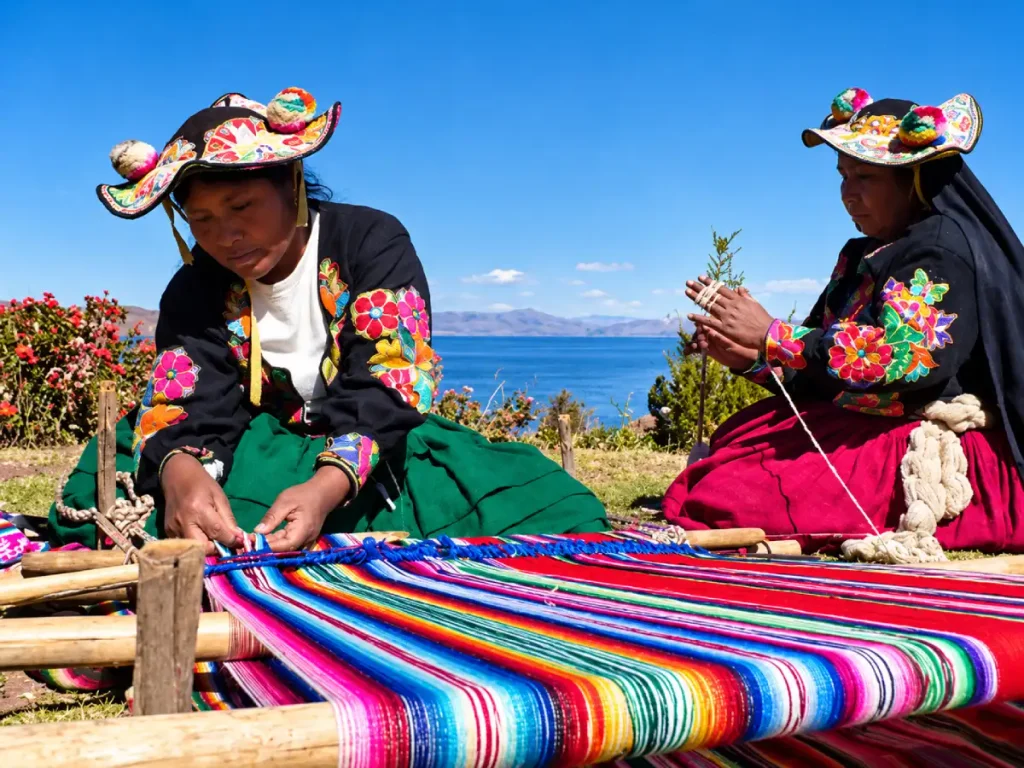
The textiles of Taquile are internationally known for both their technical quality and their cultural importance.
Patterns, colors and construction immediately attract attention, but the value of the tradition goes considerably deeper.
Certain garments can communicate information within the community, while weaving itself represents knowledge transmitted between generations.
For this reason, describing Taquile textiles simply as “Peruvian handicrafts” misses much of their cultural context.
They are part of a broader system in which textile production, clothing and community identity are closely connected.
Taquile textile art and UNESCO
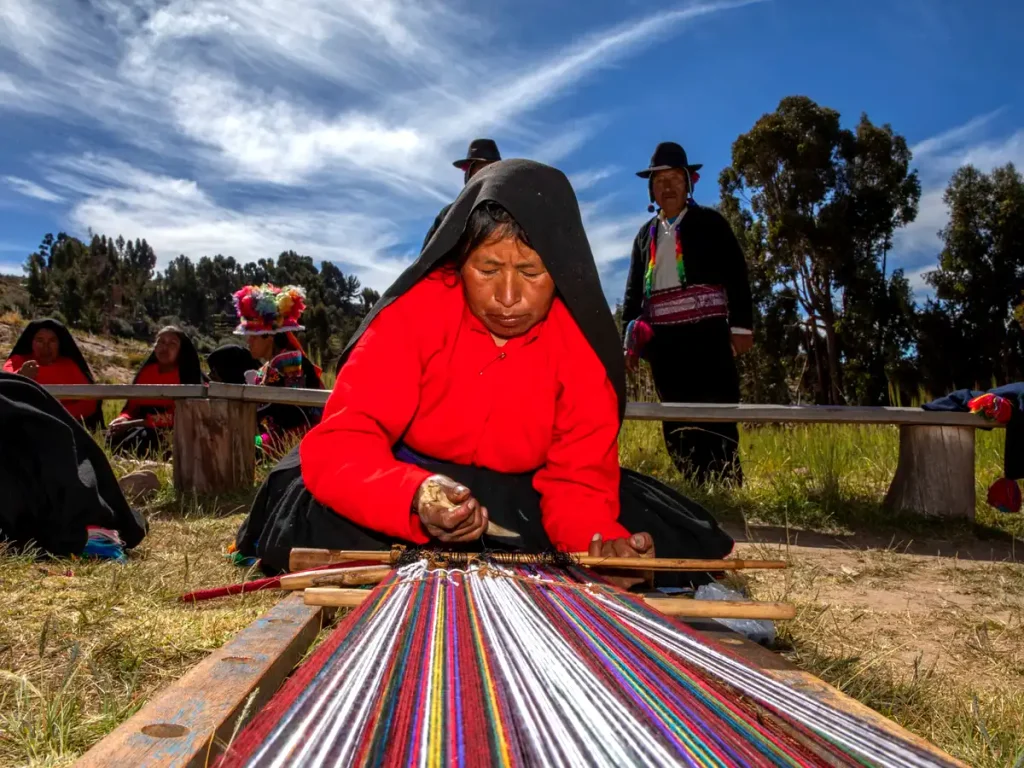
One of the main reasons Taquile textile art is internationally recognized is its relationship with UNESCO’s Intangible Cultural Heritage program.
In 2005, Taquile and its textile art were proclaimed a Masterpiece of the Oral and Intangible Heritage of Humanity. The tradition was later incorporated into UNESCO’s Representative List of the Intangible Cultural Heritage of Humanity.
The recognition goes beyond individual finished products.
It encompasses the knowledge, skills and cultural practices involved in producing and transmitting Taquile’s textile traditions.
That distinction is important. Intangible cultural heritage is not simply about preserving old objects. It also involves maintaining knowledge that continues to be practiced and passed on.
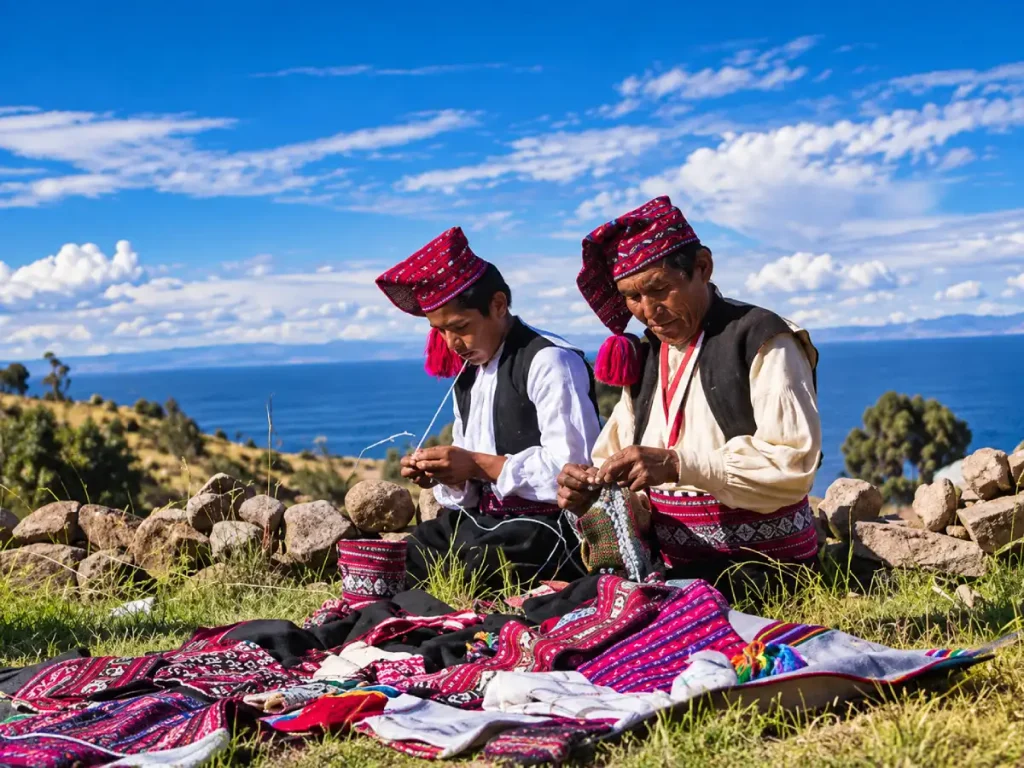
A textile tradition passed through generations
The Taquile weaving tradition is closely linked to learning within families and the community.
Skills can begin developing at a young age through observation and repeated practice.
As knowledge grows, increasingly complex techniques can be learned and refined.
This process allows textile traditions to continue as part of contemporary life rather than existing only as demonstrations for visitors.
Passing these skills from one generation to the next is one of the reasons the textile tradition of Taquile Island remains culturally significant today.
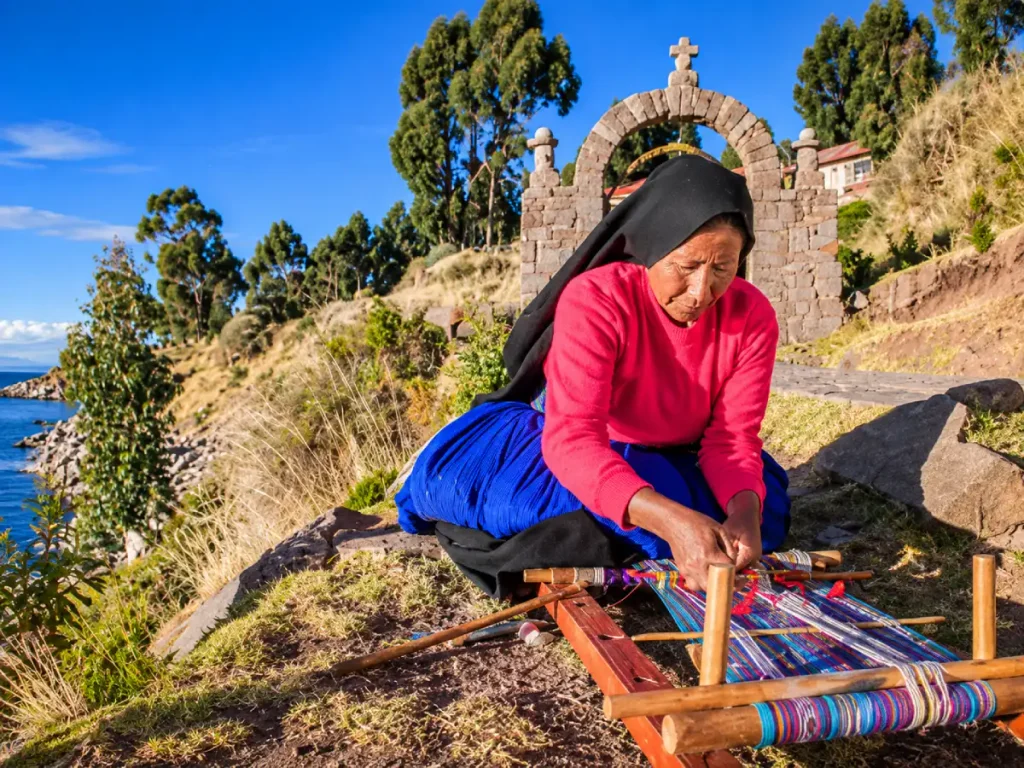
Who makes textiles on Taquile Island?
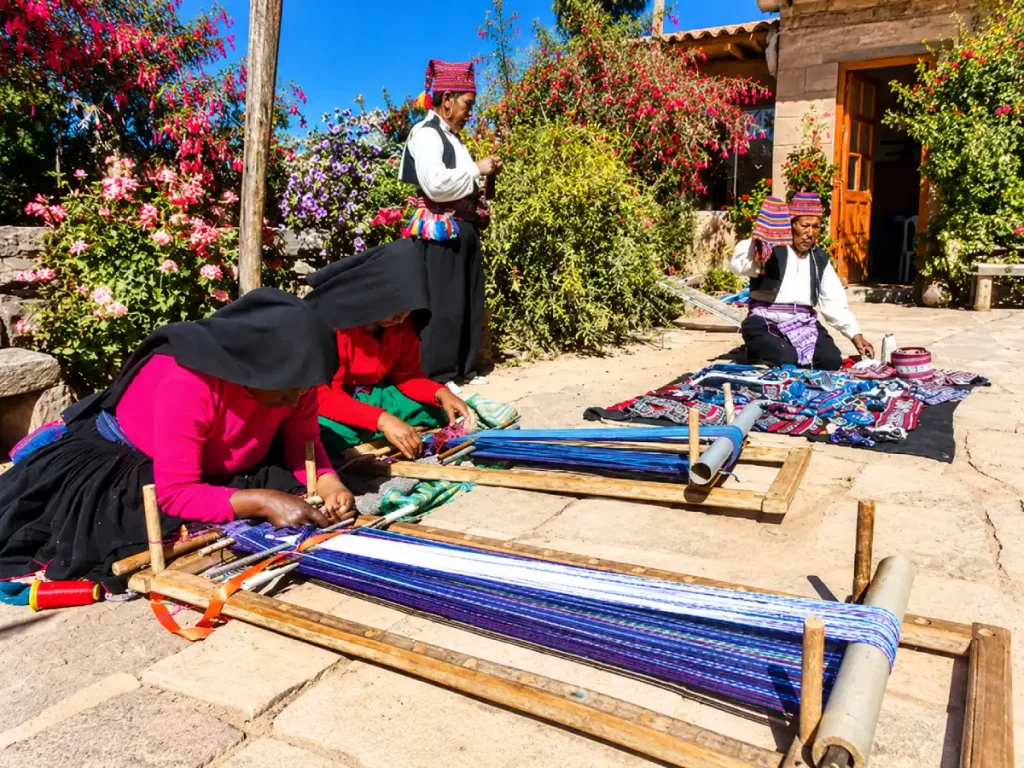
One of the most distinctive aspects of Taquile weaving is the participation of both men and women in textile production.
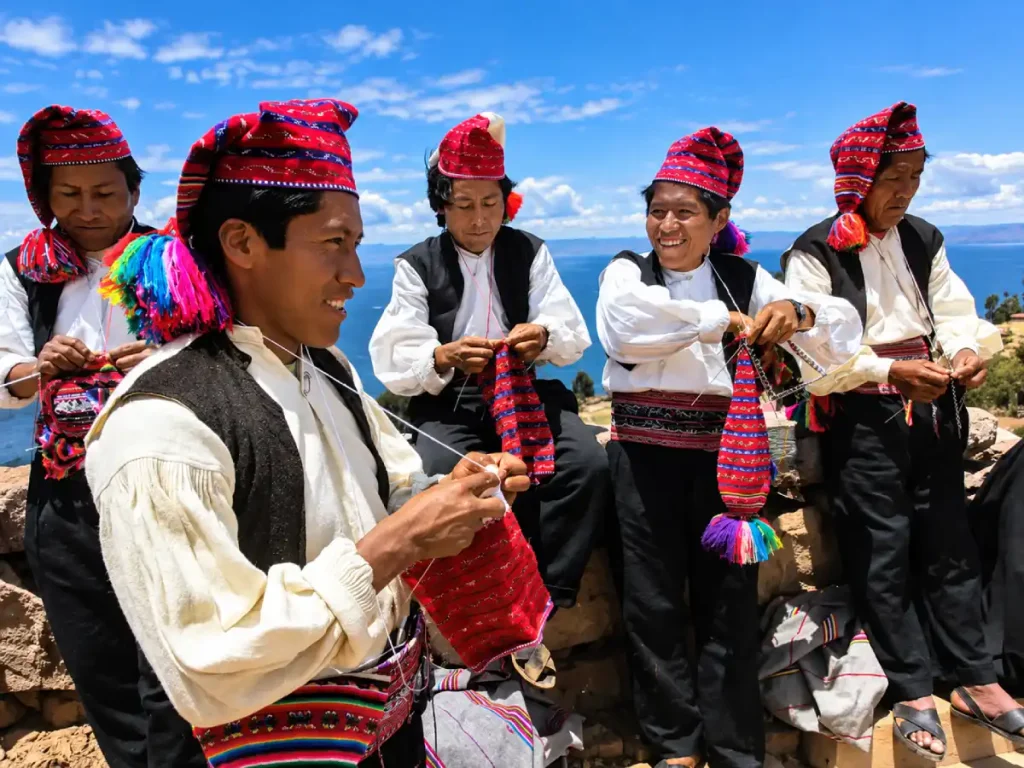
Men are particularly known for knitting, while women traditionally play important roles in spinning and weaving on looms.
These practices are learned within the community and form part of Taquile’s textile knowledge.
Visitors may even see men knitting while walking, talking or participating in everyday activities.
Rather than being separated from daily life, textile production remains visible across different parts of the island.
The famous chullo of Taquile Island
Among the best-known examples of traditional clothing on Taquile Island is the chullo, a knitted Andean hat.
Within the local cultural context, certain designs, colors or ways of wearing garments can communicate social information.
For someone unfamiliar with these traditions, those details may simply look decorative.
However, clothing can function as a form of cultural communication.
Instead of assuming that every color has one universal meaning, it is better to understand garments within their specific social context and listen to explanations provided by local residents.
The Taquile calendar belt
Another fascinating example of Taquile textile art is the woven belt, commonly known as a chumpi.
Some belts incorporate intricate motifs connected with community knowledge and agricultural life.
A particularly well-known example is often referred to as the Taquile calendar belt.
Its designs have attracted attention because textile motifs can encode information related to seasonal or agricultural cycles and aspects of community life.
Seen from this perspective, a woven belt is not merely decorative. It can also function as a medium through which knowledge and cultural memory are expressed.
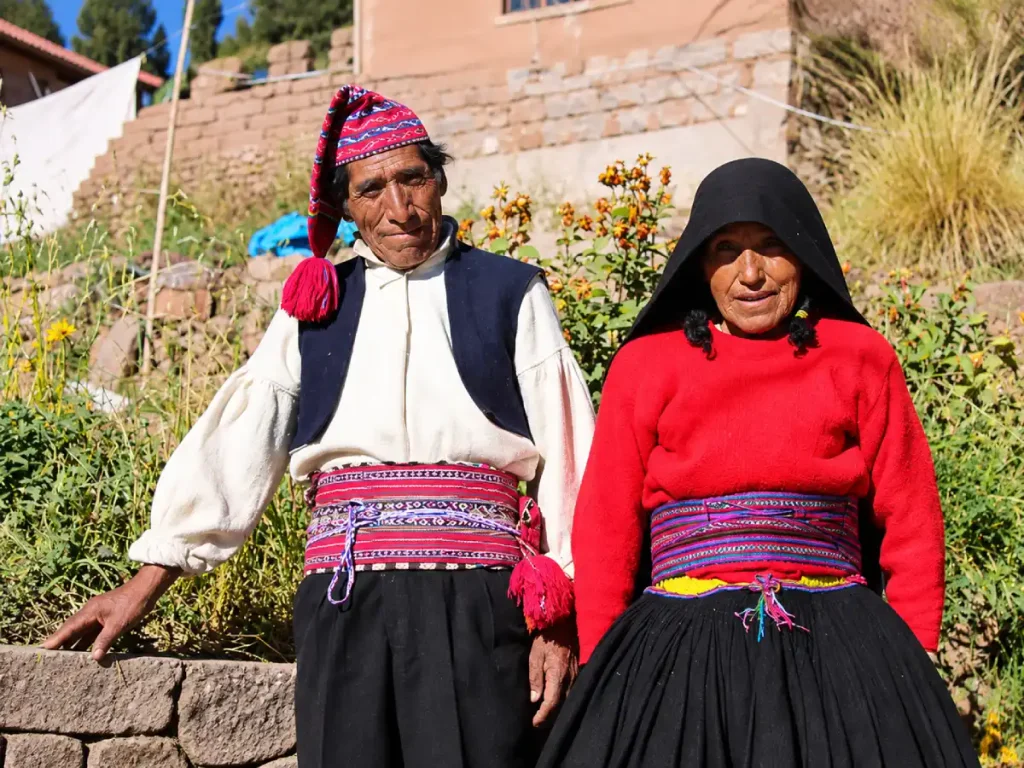
What do Taquile textile patterns and colors mean?
Travelers frequently search for the meaning of Taquile textiles, particularly the colors and geometric patterns visible in clothing.
The answer is more complex than a simple chart assigning one meaning to every color.
Different garments, designs and ways of wearing them may carry meanings depending on the person and cultural context.
Social identity, community traditions and life stages can all influence interpretation.
For that reason, avoid simplified explanations such as “this color always means this.”
When examining a particular garment, local weavers and residents are the best sources for understanding its context.
How are Taquile Island textiles made?
Producing a textile involves knowledge accumulated through years of learning and practice.
Different pieces require different techniques.
Some garments are knitted, while other Taquile textiles are produced using looms and weaving techniques.
Before the finished textile appears, fibers must also be prepared and transformed into material suitable for working.
The precision visible in many finished pieces reflects the technical ability required throughout this process.
Understanding that work makes it easier to appreciate why handmade textiles cannot be evaluated only by their appearance.
What materials are used in Taquile textiles?
Andean textile traditions have historically relied on fibers available through local production and regional exchange.
Today, textiles sold or used on Taquile may incorporate different materials depending on the garment and its maker.
Because materials can vary, travelers interested in purchasing a particular piece should ask the artisan what fibers were used and how it was produced.
This is more reliable than assuming that every product sold on the island uses exactly the same material.
It also creates an opportunity to learn more about the work behind the finished textile.
Taquile textiles and cultural identity
Clothing can communicate much more than personal style.
On Taquile, certain traditional garments have historically been connected with cultural and social identity.
Different details may communicate information recognized within the community.
At the same time, Taquile should not be portrayed as a society frozen in the past.
Communities evolve, people make individual choices and traditions interact with contemporary economic and social life.
The importance of the Taquile textile tradition comes partly from this continuity: cultural knowledge remains relevant while existing within a changing modern community.
Are traditional textiles still used on Taquile?
Yes. Textile traditions remain visible on Taquile today.
Certain garments continue to form part of local clothing and cultural practices, while textile production also provides products that can be sold to visitors.
Tourism has therefore become connected with the contemporary textile economy of the island.
Producing pieces for travelers does not automatically make the tradition culturally meaningless.
Traditional knowledge and economic activity can exist together.
The more useful question is how a particular textile was made, who produced it and what knowledge or techniques were involved.
Taquile handicrafts and tourism
Tourism plays an important role in contemporary Taquile.
Visitors arriving on the island may have opportunities to see textile work, learn about traditional clothing and purchase handmade pieces.
Buying locally produced Taquile handicrafts can also contribute to the island’s economy.
However, travelers interested in the cultural value of a piece should ask about its origin, materials and production method.
That turns a purchase into an opportunity to better understand the textile tradition rather than simply choosing a souvenir based on appearance.
Where can you buy textiles on Taquile Island?
Travelers can find locally produced textiles during visits to Taquile, although the exact places encountered will depend on the route and itinerary.
If you want to buy textiles on Taquile Island, take some time to examine the workmanship and speak with the people selling the pieces whenever possible.
Ask who made the textile, which materials were used and what technique was involved.
Carrying some cash is also sensible when visiting the island rather than depending entirely on electronic payments.
How can you identify handmade Taquile textiles?
There is no single visual rule that works for every product.
Instead, asking questions can help you understand what you are buying:
- Who made the textile?
- Was it handmade?
- Which fibers or materials were used?
- What technique was used?
- Does the design have a particular meaning?
- How long did the piece take to make?
These questions provide considerably more useful information than simply looking for a specific pattern or color.
They also help travelers understand the time and skill involved in traditional Taquile weaving.
Experiencing textile culture while visiting Taquile
The cultural importance of textiles becomes easier to understand when you see them within the landscape and community where the tradition continues.
A typical visit to Taquile combines walking, Lake Titicaca scenery and opportunities to learn about aspects of local culture.
Knowing something about the island’s textile heritage beforehand makes it easier to recognize details that might otherwise go unnoticed.
If you are planning the logistics of your trip, our guide on how to visit Taquile Island from Puno explains transportation, boat travel time, walking conditions and how to combine Taquile with the Uros Islands.
Taquile, Uros and Amantani: different Lake Titicaca experiences
Traveling across Lake Titicaca introduces visitors to communities with different histories and cultural landscapes.
The Uros Islands are especially known for their floating platforms constructed using totora reeds.
On Taquile, the natural island landscape, agricultural terraces and textile traditions are major elements of the experience.
Meanwhile, Amantani is commonly included in longer itineraries that allow travelers to spend more time around the lake.
Rather than seeing the islands as interchangeable attractions, understanding these differences helps travelers decide how much time to dedicate to Lake Titicaca.
Are Taquile Island textiles worth learning about?
Travelers interested in Andean culture, craftsmanship or living heritage will find that understanding the textiles of Taquile Island adds considerable depth to the visit.
You do not need to purchase a textile to appreciate the tradition.
Learning who creates the garments, how techniques are transmitted and why clothing can carry social meaning provides context for what you see while walking around the island.
The cultural value of Taquile textiles is not based solely on their colors or appearance.
It also lies in the knowledge required to create them and in the people who continue passing that knowledge from one generation to another.
Frequently Asked Questions About Taquile Island Textiles
Why are Taquile textiles famous?
Taquile textiles are known for their technical quality, cultural significance and the transmission of textile knowledge across generations. Taquile and its textile art have also received international recognition from UNESCO.
What is special about Taquile Island textiles?
Their importance extends beyond appearance. Textile production is connected with cultural knowledge, social identity and traditions maintained within the community.
Do men knit on Taquile Island?
Yes. Men are particularly known for knitting, while women traditionally have important roles in spinning and weaving on looms.
What is a Taquile chullo?
A chullo is a knitted Andean hat. On Taquile, particular designs and ways of wearing traditional garments can have meanings within the local cultural context.
What is the Taquile calendar belt?
The term refers to certain woven belts whose motifs can represent aspects of agricultural cycles, community knowledge and cultural memory.
What do the colors of Taquile textiles mean?
There is no reliable universal rule assigning one fixed meaning to every color. Interpretation can depend on the garment, design, wearer and social context.
Are Taquile textiles UNESCO heritage?
UNESCO recognizes Taquile and its textile art as part of the world’s Intangible Cultural Heritage. The recognition concerns the knowledge, skills and cultural practices associated with the textile tradition.
Can you buy textiles on Taquile Island?
Yes. Travelers can find textiles produced on the island. Asking about the maker, materials and production technique is useful when choosing a piece.
Is Taquile Island worth visiting for its textile culture?
For travelers interested in Andean culture and traditional craftsmanship, textile heritage provides an important additional reason to visit Taquile alongside its landscapes and Lake Titicaca scenery.
Discover Taquile’s Textile Heritage on Lake Titicaca
The Taquile Island textile tradition represents much more than colorful clothing.
Behind each piece are techniques, skills and cultural knowledge developed and transmitted through generations.
Learning about this tradition provides a deeper understanding of Taquile and helps travelers see the island beyond its spectacular Lake Titicaca scenery.
If you want to experience this cultural heritage in its original setting, read our guide on how to visit Taquile Island from Puno and explore our Lake Titicaca tours from Puno.