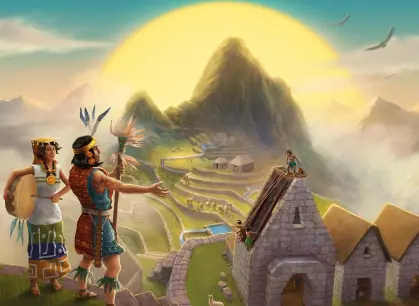
The Inca Empire, also known as Tahuantinsuyo, was the largest and most powerful civilization in South America before the arrival of the Spanish. With its capital in Cusco, the Incas created an organized, advanced empire deeply connected to nature.
In this article, you’ll discover what the Inca Empire was, how its people lived, what achievements they reached, and why their legacy lives on today.
🌎 What Was the Inca Empire?
The Inca Empire was a civilization that developed in the Andes from the 13th to the 16th century. It stretched over 4,000 kilometers, covering territories of present-day Peru, Bolivia, Ecuador, Colombia, Chile, and Argentina.
Its original name was Tahuantinsuyo , which in Quechua means “the four united regions.”
🗺️ Extent of the Empire
The empire was divided into four main regions or suyos , all connected by roads and governed from Cusco, considered the “navel of the world” :
- Chinchaysuyo – to the north, reaching Ecuador and Colombia.
- Antisuyo – to the east, toward the Amazon jungle.
- Contisuyo – to the west, along the coast.
- Collasuyo – to the south, extending into Bolivia and Chile.

👑 Political and Social Organization
The supreme ruler of the empire was the Inca , believed to be a descendant of the Sun God (Inti ). The entire system was based on community work, resource redistribution, and respect for nature.
🔹 Main Social Structures:
- The Ayllu : family groups that shared land, labor, and resources.
- The Curaca : local chief who represented the Inca.
- The Mita : a system of collective labor for the benefit of the state.


🏗️ Major Achievements of the Inca Empire
Despite having no writing system or wheel, the Incas stood out for their knowledge of engineering, agriculture, and organization:
- Road Network : over 30,000 km of roads known as the Qhapaq Ñan .
- Stone Architecture : such as Machu Picchu and Sacsayhuamán, built without cement.
- Advanced Agriculture : agricultural terraces, irrigation canals, and storage facilities called tambos .
- Quipus : knotted ropes used to record information.

🌞 Religion and Beliefs
The Incas were polytheistic. Their main god was Inti , the Sun, but they also worshiped:
- Pachamama (Mother Earth)
- Viracocha (the creator god)
- Apus (spirits of the mountains)
They performed ceremonies and offerings to maintain balance with nature.uilibrio con la naturaleza.


⚔️ The Conquest and Fall of the Empire
The Inca Empire came to an end in 1533 , when the Inca Atahualpa was captured by the Spanish led by Francisco Pizarro . A civil war between Atahualpa and his brother Huáscar weakened the empire just before the arrival of the conquerors.
However, Inca culture never fully disappeared. Many traditions, the Quechua language, and their deep respect for nature live on.
✨ The Legacy of the Inca Empire
Today, the Inca legacy is felt in every corner of Cusco, in festivals like Inti Raymi , in traditional clothing, native languages, and archaeological sites visited by millions of travelers each year.

🧠 Frequently Asked Questions
Did the Incas use writing?
No, but they used quipus as a recording system.
Who was the most famous Inca?
Pachacútec , considered the founder of the empire and builder of Machu Picchu.
Why was Cusco the capital?
Because it was the spiritual, political, and geographic center of the empire.
✅ Conclusion
The Inca Empire was an organized, cooperative, and advanced civilization that left a lasting mark on the history of Peru and Latin America. Today, traveling through the ancient Tahuantinsuyo is a way to connect with that living history.
🎯 Want to see the Inca legacy with your own eyes?
At Top Inka Travel , we take you to visit the most iconic sites of the Inca Empire:
📲 Contact us here and plan your trip with local experts.